Hippology Stations Resources
The Stations Phase gives 4-H members hands-on opportunities to apply their horse knowledge through a series of short, timed learning stations. Participants rotate among stations or tables that focus on different horse-related topics and materials. At each station, members answer questions that test both identification skills and the ability to apply equine knowledge in practical situations.
A typical hippology contest includes approximately 20 stations. Each station is a 2-minute, visual identification or problem-solving task. Contestants may be asked to identify physical items or respond to questions using photographs, diagrams, samples, or written scenarios. This phase emphasizes real-life situations and encourages critical thinking, observation skills, and practical decision-making.
Examples of Hippology Stations
- Color Identification: Identifying horse colors and patterns such as bay, black, buckskin, palomino, tobiano, overo, dun, gray, and others.
- Feed Identification: Identifying common grains, hays, and feed supplements and understanding their uses.
- Anatomy Identification: Labeling parts of the skeletal system, muscles, or digestive system using diagrams or images.
- Tack Identification: Identifying bits, bridles, saddles, or other tack and equipment.
- Health & Management: Answering questions based on photos or scenarios, such as identifying signs of illness, management concerns, or grooming equipment.
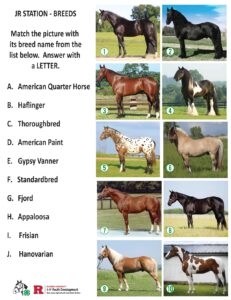
Example Junior Station

Example Senior Station